Housing, inequity, scapegoats, and political will
Australia’s housing crisis is often narrated as a problem of scarcity: not enough houses and too many immigrants taking Aussie’s homes. Such claims can, however, obscure an unsettling fact: Australia is a wealthy country that is able, at least in aggregate, to house all existing households. The problem is not some simplistic scarcity; it has much more to do with access, distribution, and political will.
Admittedly, Australian housing is currently mismatched; some dwellings are holiday homes, temporarily vacant, unsuitable, or distant from infrastructure or support networks. The philosophical character of the problem, however, remains: we are not dealing with scarcity, but allocation.[1] Where some Australians don’t have a home, others own (and profit from owning) many houses. To be clear, there are more houses in Australia right now than households requiring one: 11.50 million dwellings[2] – 10.79 million households[3] = about 708,000 more dwellings than households.
Decades of public policy have allowed real estate to become one of the principal engines of private capital accumulation while allowing persistent homelessness, expensive renting, and declining access to home ownership as if these were unavoidable features of economic life. They are not natural, should not be seen as ‘normal’ or fair, and ought to be challenged. They are a manufactured reality we can change!
The scandal is not simply that Australia has too few houses due to excess migration. It is that access to an abundant social resource is mediated by a massive disparity of accrued capital.
A house can be both a place you live or something you own that increases your wealth. Unadjusted over time, property owners (especially those who own multiple properties) increasingly accumulate wealth and at other’s expense. Since 1999, Australian homes have risen by more than 400%,[4] (twice as much as average full-time earnings) despite the asset itself remaining essentially the same. This has made first home ownership harder, if not impossible, for younger people starting out in life, with purchasing power already favouring established asset holders.
Economic asymmetry like this creates economic winners and losers. The wealthiest 10 per cent of Australian households are around 15 times wealthier than the lowest 60 per cent. Because wealth accrues, if not adjusted for, it continues to concentrate with the already wealthy. Nearly half of the increase in household wealth since 2003 accrued to this wealthiest 10 per cent alone. Property ownership is central to that concentration, with those renting transfer a substantial portion of their income to those who own the house they rent.[5]
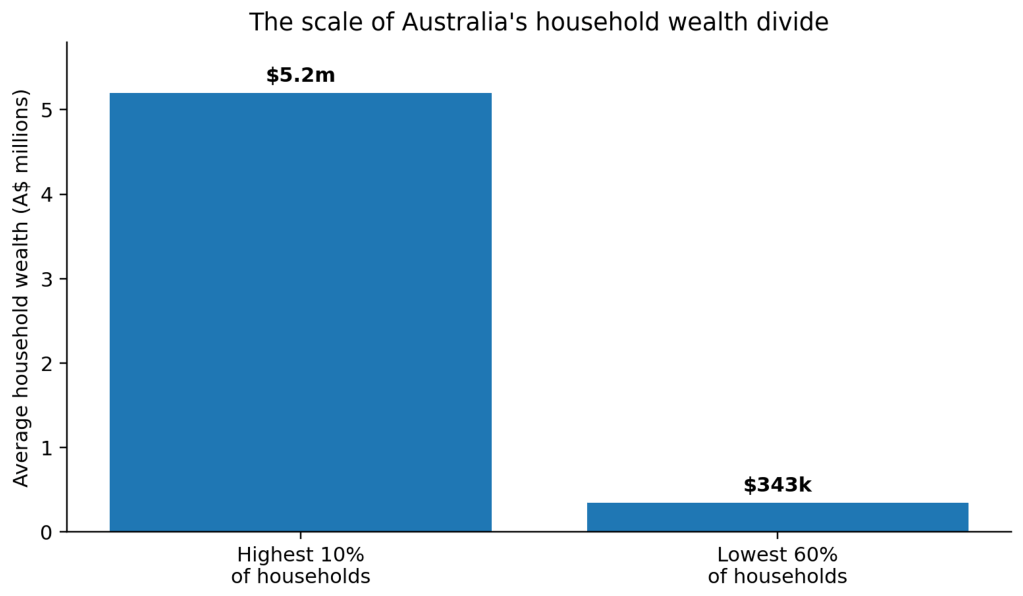
Figure 2. Average household wealth at opposite ends of the distribution. Source: ACOSS–UNSW, Inequality in Australia 2024.
This has happened, in part, because Australian government policy has disproportionately favoured the accumulation of wealth for existing asset owners;[6] especially for households at the top of Australian wealth distribution.
A home is where people sleep, raise children, maintain relationships, study, seek employment, recover from illness, and participate in civic life. A chronic lack of housing, therefore, imposes costs far beyond rent. It diminishes the practical freedom from which other forms of freedom become possible.
A housing market, amongst other things, functions as a mechanism that allows the wealthy to increase their wealth (and influence/power). When shelter is simply another commodity, and not treated as a human right, an unchecked market will produce terrible inequity. Australia publicly guarantees[7] schooling, emergency medicine, hospital access, public transport access, physical security, income support, etc. because we recognise that some goods are too fundamental to human agency to be distributed solely according to ‘the market.’ Suitable housing for every citizen, I would argue, belongs in that category.
The question is not, ‘Can all Australians own their own home?’ It is, ‘What does it say about us when we can make that happen, and choose not to?’
A fairer Australia should see nobody involuntarily homeless, and make home ownership within the reach of all Australian households; not just a wealthy elite. Some sort of mechanism must exist that corrects runaway benefits for some at the expense of others struggling to just get by. Housing security for all must be prioritised over the extreme accumulation of capital for some.
One such mechanism that could achieve this is a progressive levy on extreme net wealth, protecting a generous threshold for each person and applying modestly only to wealth above it. For example, capital beyond $2 million net worth[8] incurs a small additional tax of 1% or 2% that could, over several years, steadily redirect hundreds of billions dollars from the wealthiest households towards those experiencing housing insecurity while also making home ownership a reality for all hardworking Australian households.
Where political rhetoric increasingly treats homelessness and first-home ownership as impossibly expensive, and enormous concentrations of private wealth as a fixed feature of society, such change would quickly prove both false. A public housing fund could see Australia eliminate homelessness within years, before shifting focus to first-home buyer grants in the order of hundreds of thousands of dollars.[9]
In a future where construction technology changes, supposing robotic systems unlock durable, low-carbon homes built cheaply from renewable resources, modest housing for all is not difficult to picture. Housing becomes a realised human right, and widespread home ownership becomes a reality. It need not confer a right to any house, in any location, at any price, but society can guarantee sufficiency without guaranteeing luxury.
Home ownership in Australia is worth defending as a social good. If home ownership really is part of the Australian social ideal, then a system in which some Australian households accumulate their fourth or fifth dwelling while others cannot securely possess their first deserves to be called out. Anything less is not just unfair, but unAustralian.[10] Yes, any serious reform will create losses as well as gains. The ethical question is not whether we can design a policy in which nobody gives anything up. It is whether preserving every increment of accumulated wealth is more important than securing the conditions of stable social membership for those who currently possess little.
The underlying philosophical question of all this is an old one: how much is enough? A liberal society has good reasons to permit people to save, own, inherit, invest, and enjoy the fruits of successful enterprise. Equity need not mean sameness. But the moral defence of very large private fortunes becomes weaker when moderate redistribution can secure basic goods, such as secure shelter for all. Major benefits for many Australians at the minor expense of the wealthy few is not an unreasonable ask. Taxing someone worth $10 million a little more does not likely even require them to live more simply. Redistributing that wealth to those who don’t even have $10,000 in the bank helps them to simply live! We do not lack the means to make such change. When a government lacks the political will for such change, the interests of those whom it servers become obvious! The elite few! And at the expense of every other hard-working, everyday Australian.
Beyond the sloganisms, fear-mongering, and false promises, who has the political party you intend to vote next historically favoured in shaping the socio-economic landscape of Australia’s housing crisis? If you don’t own your own home, you might want to make a deliberate effort to check you’re not voting against your own interests. Many would be shocked! It is one thing to allow a politician to stoke your xenophobia and anger, only to be further disenfranchised. It is another to see if they have historically put their money, voice, and vote where their mouth is, and have any intention of making your life better as they pursue their political interests!
References
Australian Bureau of Statistics. “Estimating Homelessness: Census, 2021.” Canberra: ABS, 2023. Source
Australian Bureau of Statistics. “Housing: Census, 2021.” Canberra: ABS, 2022. Source
Australian Bureau of Statistics. “Total Value of Dwellings, March Quarter 2026.” Canberra: ABS, 2026. Source
Australian Bureau of Statistics. “Household and Family Projections Australia, March Quarter 2026.” Canberra: ABS, 2026 Source
Australian Institute of Health and Welfare. Housing Assistance in Australia 2026. Canberra: AIHW, 2026. Source
Australian Council of Social Service and UNSW Sydney. Inequality in Australia 2024: Who Is Affected and How. Sydney: ACOSS and UNSW, 2024. Source
Footnotes
[1] To provide some idea of distribution, the Australian Bureau of Statistics reported approximately 10.85 million private dwellings in the 2021 Census, with 9.28 million occupied, leaving 1.044 million dwellings empty. This doesn’t account for some households have multiple dwellings available to them; some dwellings being holiday properties; some between occupants; some uninhabitable, but it does help reframe some of the deliberately disingenuous political rhetoric that scapegoats migrants and other causes as being the main issue.
[2] https://www.abs.gov.au/statistics/economy/price-indexes-and-inflation/total-value-dwellings/latest-release?utm_source
[3] https://www.abs.gov.au/statistics/people/population/household-and-family-projections-australia/latest-release?utm_source
[4] https://ministers.treasury.gov.au/ministers/jim-chalmers-2022/speeches/2026-27-budget-speech-parliament-house-canberra?utm
[5] The home owner not only receives the renters ‘dead’ money, but reaps the benefit of the capital (the house) appreciating in value.
[6] Through tax settings, credit, planning, land scarcity, investor incentives, and the political protection of property values,
[7] Admittedly, to varying degrees
[8] The exact rate are matters for serious fiscal modelling, and beyond the scope of this post.
[9] Policies intended to redistribute wealth downward would need careful attention, so as not to be captured by existing landowners through higher prices, allowing for the acquisition of a modest primary residence for all households. The objective could not be a gross, thoughtless giveaway to everyone of half a million dollars. Policy would need to ensure that lack of inherited or accumulated capital is not, by itself, a permanent exclusion from secure housing or home ownership. High-quality public, community, or cooperative housing could provide an ongoing guarantee against homelessness.
[10] A nationalist housing policy asks who should be allowed into the Australian property market. A distributive housing policy asks how property and security should be shared among the people already here. The questions overlap, but they are not substitutes.
 andrewwalton.com.au